Friday, 27 June 2014

ID'ing a Northern Amber Bumble Bee

After recently receiving a copy of "North American Bumble Bees - An Identification Guide" (by Williams, Thorp, Richardson, & Colla) I've been out catching and studying these insects... and with limited success in identifying them. I don't think the book is to blame, it's just that they're very difficult to identify.

So far I've only identified the Northern Amber Bumble Bee with confidence, and the Fernald Cuckoo Bumble Bee with a little less confidence. It seems that about 20 - 30% of the bees I see are Northern Amber Bumble Bees, and over 50% are Fernald Cuckoo BB's. I've caught at least 2 other species but haven't been able to identify them yet.

I caught two Northern Amber Bumble Bees and now have them as specimens. Today I took photos to demonstrate how I identified them using the method laid out in the guide book.

Here's a picture of a Northern Amber Bumble Bee (Bombus borealis):

The first step towards identifying female (which most of the ones we see are) bumble bees is to look at the tibia of the hind leg. In the Northern Amber BB it is flat, reflects light, and has no hair on the broad surface, but long hair on the front and back edges of the tibia:


The next step is to look at the midleg - the distal (bottom) posterior (back) corner of the basitarsus (last large segment of the leg + foot) is pointed not rounded.

 The mandible has 3 (?) keels that extend along the outer surface. The front most keel extends all the way to the distal margin of the mandible. This is not easy to see and requires the correct angle of light.
In the above photo you can see that the flat surface (clypeus) - between the eyes and below the yellow hair - is smooth and shiny.
Also, the hair just above the clypeus is not black, but a creamy-yellow colour that is paler than the hair on the Tergum (the upper surface of the third body part).

dIn the next photo you can see the stinger of the bee. Preceding this are two sections (T5 & T6) of the tergum that are entirely black, and preceding these two sections are another 4 sections which are entirely golden-yellow (T1 - T4). 


That's the method of identifying this species of bumble bee using the Identification Key outlined in it the book. After identifying my first couple this way, I can somewhat confidently identify them in the field simply by looking at the golden-yellow tergum that is mostly yellow and black near the back - and also based on the size (about 2cm long).

The Yellow Warblers in my yard had 4 eggs in their nest last week - which have now hatched:

Friday, 20 June 2014

Newfoundland eBird

eBird use has been growing by leaps and bounds in Newfoundland over the last year. I'm a little (*very*) obsessed with eBird so I may be the only person who will ever be interested in this?

In previous years less than 5 of the local birders used eBird regularly, but this year after completing some missionary work we have at least 12 locals using it on a regular basis!

Some milestones we've reached:

- For the first time in Newfoundland eBirding history over 1000 checklists have been submitted from the avalon peninsula in one month (that was in May)!

- Another big milestone we already reached this year is to have 10 people submit over 100 checklists (previous record was 4), and 8 people with over 100 species submitted (previous record was 7). And we're only at the half way point!

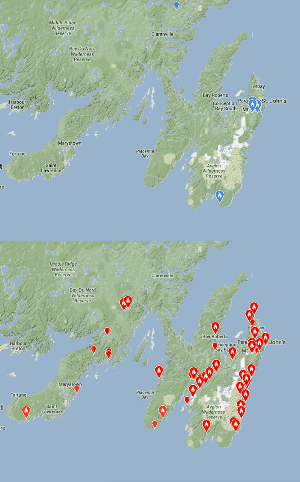
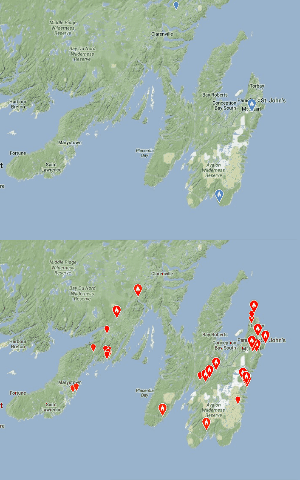
- Anyway, the real reason this should be exciting is because more data is being contributed to the database and is publicly available. Check out these maps for Northern Waterthrush and Yellow-bellied Flycatcher sightings - blue is from 2013, orange is from 2014.

Northern Waterthrush:

Yellow-bellied Flycatcher:

Big differences in those 2 years!


Some photos from this morning at Cape St. Francis:


Wouldn't be a cape in Newfoundland if there weren't pipits:


Sunday, 15 June 2014

Icebergs!

This spring has been phenomenal for icebergs around Newfoundland. There's been a steady of stream of the white towers heading South. And in the last couple of weeks two large ones have grounded themselves between St. John's harbour and Cape Spear offering great looks and photos that are easy to impress people with!


The tourist boats are making a lot of money off them this week!
 I even heard that taxi's are having a very busy week with all the people in town for business meetings hoping to see an iceberg!


Really neat texture on these things:


My only bird pic from this weekend:

bees bees bees... Bumble Bees!

moths...

I swear I still do go birding - I just don't take pictures of birds. I'm a little jaded when it comes to taking photos of birds so it's hard to fill these blog posts with fresh bird pics...


Today I saw my first Mourning Warbler of the year - I photographed this one in Waterloo 2 years ago: