Saturday, 17 August 2013

One for the Gyr

(Apparently this didn't get posted 2 weeks ago when I had hoped it would... so here it is - buying me more time)

As I alluded to in a previous post, there were several predators that regularly harassed the shorebirds in our area on the Mackenzie Delta. The most unexpected of these, and most exciting was the Gyrfalcons!

And yes, there was more than one! And it gets even better :)

On our first day at camp it didn't take long to notice 2 falcons regularly hanging out around an abandoned communication tower that was literally 500m from our camp.

At that time, the area around their nest was entirely flooded so I wasn't able to get close to their nest and territory.


Soon enough the water receded, providing plenty of area for them to land on the ground where the adults often fed:


We soon learned where the favourite perches of the female and male were. The male preferred the very top of the tower, while the female usually hung out lower and closer to the nest, which was only about 1/5th of the way up the tower.

On June 21st, I climbed the 15 meters up the tower to look into the nest. I thought my biggest threat would be the adults if they decided to dive-bomb me. But they remained on their perches and only stared at me. I was however surprised by how loud and scared the chicks were when I stuck my head up. I decided to only remain long enough to get a picture before leaving:

On July 10th I returned to the nest with determination to ignore the screams of the chicks. By that time they had grown many more mature feathers, including their flight feathers. But they were still flightless so they couldn't flee my approach.

Although it doesn't seem like it in this picture, the bird on the right was noticeably larger than the one on the left. The size difference is probably due to gender, not age.


The main purpose of this visit was to see what birds they fed on, and to make sure there were no satellite transmitters from Whimbrels of Hudsonian Godwits in the nest. The transmitters cost over $3000, so it was worthwhile to see if one had made its way into the nest. Thankfully, no transmitters were found; however, many bird remains were found in the nest, and on the surrounding bog.

Here's a photo of all the bird parts we found:

We only managed to identify the remains of 3 species:
Willow Ptarmigan: By far the most common prey, with a minimum of 10 individuals found.
Whimbrel: Easily the second most common prey, with a minimum of 4 individuals found!
Northern Pintail: we found an intact head of 1 Northern Pintail.

Here's one of the Whimbrel wings:

The white primary shaft of the outer most primary confirms that this is a curlew species (Whimbrels are a type of curlew):

Kind of gruesome, but at least it's identifiable as a Pintail!

Willow Ptarmigan foot. We were surprised that Willow Ptarmigan were their favoured prey because there was no suitable habitat for ptarmigans close by, yet there were many breeding pairs of Whimbrel. Why would they fly several kilometers just to catch ptarmigan? Probably because it's an easy bird to catch, and there's a lot of meat on them.


Looks frightening, but I only suffered a tiny scratch on one of my fingers after the ordeal:

On June 19th the adult Gyrfalcons demonstrated their strength by chasing down an adult Peregrine Falcon that strayed too close to their nest. Both adults were on its tail, with the female directly behind the Peregrine, and the male also behind but higher than the other 2 birds. Eventually the adult Gyr's drove the Peregrine to the ground where they made quick work of its existence. Within 2 minutes they abandoned the dead Peregrine and returned to their watch posts by the nest.

 True story.

Tuesday, 30 July 2013

Haida Gwaii - Part 2

Here's a selection of some of the more interesting birds and scenery we came across on the island.

Red Crossbills were surprisingly common on the island:

On the 24th, Mira and I ventured to the more unexplored Western coast of the island. We drove over several small streams and during each crossing we wondered if an American Dipper might reside along the stream. We agreed on which stream looked the best and hiked up the stream early the next morning. Amazingly, we found one less than 500 meters up the stream. I'm not sure if they're common in the area or if we were just lucky...
We only got a 5 second look at it before it flew away.

It had a beautiful home:


Sea Anemone's were common on the rocky beaches:

As were sea stars:

Marbled Murrelets were fairly common on the inlets and bays around the island, but not common in exposed areas:

Two species which I thought were going to be common on the island were Harlequin Duck & Black Oystercatcher. Surprisingly, we only saw both species in one location: Queen Charlotte City.


Today (July 30th), I'm in Moosonee, Ontario. Tomorrow I am joining Mike Burrell, Barb Charlton, & Ross Wood on a flight to Hannah Bay, James Bay where we'll be doing shorebird surveys for the next two weeks. After that, I'm headed back home to St. John's for 4 (and probably more) years :-)


Sunday, 28 July 2013

Queen Charlotte Islands - Part 1

Just got back from visiting the Queen Charlotte Islands (now known as Haida Gwaii) with Mira for 5 days. It was my first time in BC, and my first time visiting the Pacific Ocean from Canada's perspective.

Needless to say, there were many species (and sub-species!) that I've never seen before.

The islands are a 7 hour ferry ride from Prince Rupert. The ferry ride is known as one of the better opportunities to see pelagic species in the area. We didn't see much diversity but did see thousands of alcids, and thousands of Sooty Shearwaters. Although I didn't manage to find a Short-tailed Shearwater, I'm sure they were around...


Mira has been trying to convince me to go to these islands for almost 2 years now. I never gave them much thought because there are a million places I want to go to. But now that we've been, I'm happy we went! One of the best spots is the north beach of Naikoon Provincial Park. We hiked this beach (~30km round trip) to the tip of Rose Spit, which is basically a point of sand very much like Point Pelee. Only bigger, and a lot less people, and it juts out into the ocean :)


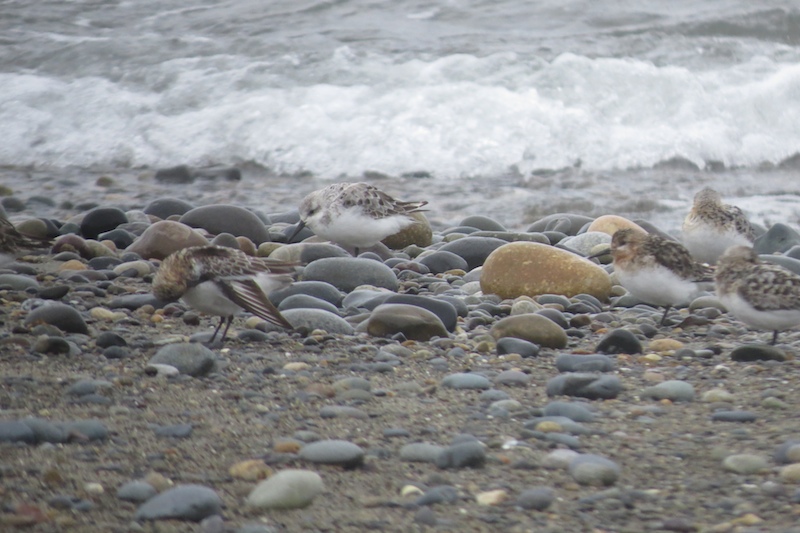
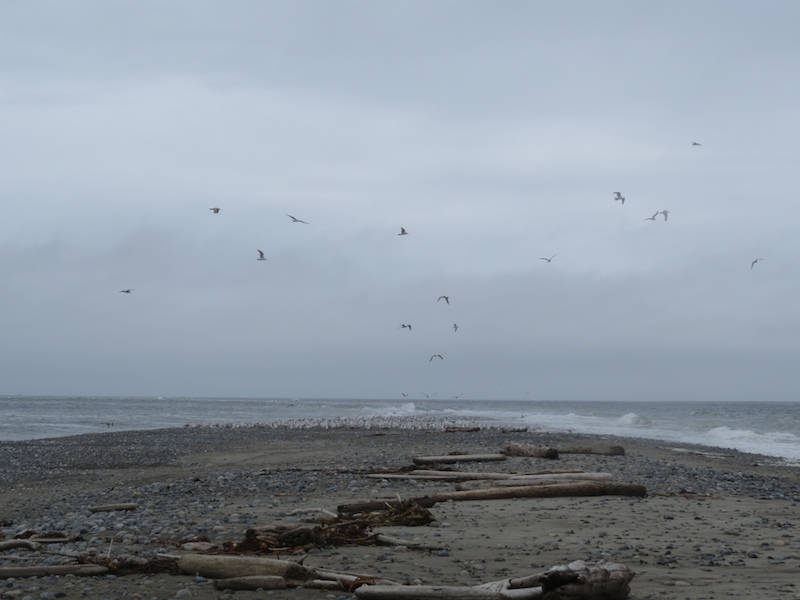
The hike was well worth it! We started just as the tide was at its lowest point for the time of year, exposing over 500 meters of sand between the high tide line and the water. Perfect for shorebirds. Thousands of them! Incredibly, despite the abundance of shorebirds there were only 3 species: Sanderling, Semipalmated Plover, & Western Sandpiper. I was a bit surprised by this, but the varying molt stages of the many shorebirds kept me interested.

Some Sanderlings were already well into their winter plumage, most were closer to their summer plumage which was more unfamiliar to me:

 Shorebirds were spread out along the entire 500m by 15km beach:

Having never seen Western Sandpipers, I was eager to get close up looks at them:

Most Semipalmated Plovers were still in breeding plumage, but some were already in the duller winter plumage:

A baby Dall's Porpoise was satisfying a handful of Ravens and Gulls.

Here's a view of the point looking inland:

And the other direction:

A close to shore Yellow-billed Loon was the biggest surprise for the day:


 boat and distant Tow Hill


More photos to come ... perhaps