Saturday, 20 July 2013

Mackenzie Delta species list

A boring post here...
Simply a list of all the bird species I saw in the Mackenzie Delta with the percentage of eBird checklists that included that species!


I underlined the two most interesting species/percentages:

  • The European Starling was way out of range (1000km), but didn't spark much excitement in our group!
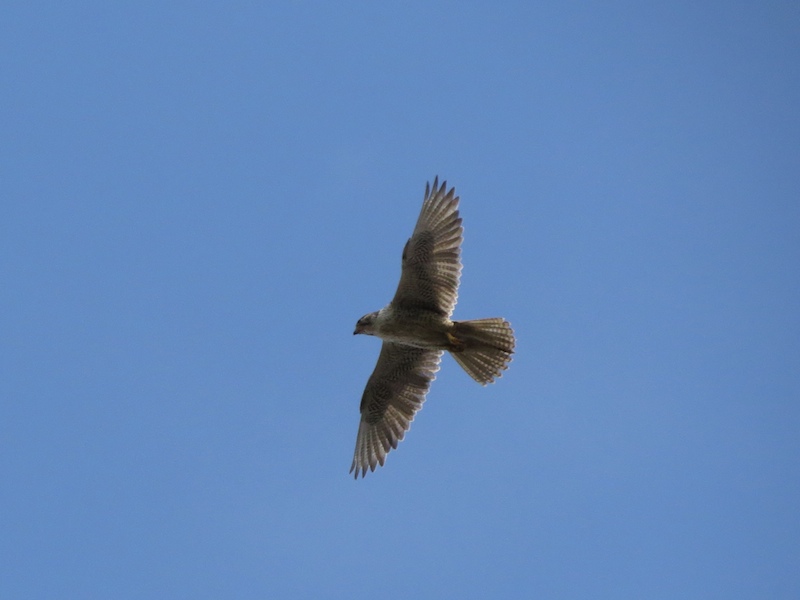
  • The Gyrfalcon was another unexpected bird, except this time we were excited to see it and it stuck around for the entire duration of our stay because a pair had a nest a mere 500m from our camp! I'll be devoting a post to those birds eventually...


Total # of species: 76
Total # of eBird checklists: 47
Time period: 6 June, 2013 - 12 July, 2013
Location: Mackenzie Delta, Northwest Territories


Species Name Percentage
Greater White-fronted Goose 94%
Snow Goose 4%
Brant 4%
Cackling Goose 17%
Canada Goose 9%
Cackling/Canada Goose 64%
Tundra Swan 89%
Gadwall 2%
American Wigeon 68%
Mallard 55%
Northern Shoveler 89%
Northern Pintail 96%
Green-winged Teal 36%
Canvasback 6%
Greater Scaup 2%
Lesser Scaup 85%
Surf Scoter 2%
White-winged Scoter 36%
Long-tailed Duck 30%
Common Goldeneye 2%
Red-breasted Merganser 17%
Willow Ptarmigan 21%
Red-throated Loon 30%
Pacific Loon 79%
Horned Grebe 2%
Golden Eagle 2%
Northern Harrier 51%
Bald Eagle 15%
Rough-legged Hawk 17%
Sandhill Crane 89%
Black-bellied Plover 6%
American Golden-Plover 13%
Semipalmated Plover 72%
Spotted Sandpiper 2%
Lesser Yellowlegs 15%
Whimbrel 60%
Hudsonian Godwit 49%
Sanderling 2%
Semipalmated Sandpiper 28%
Least Sandpiper 57%
White-rumped Sandpiper 2%
Pectoral Sandpiper 64%
Stilt Sandpiper 66%
Long-billed Dowitcher 19%
Wilson's Snipe 72%
Red-necked Phalarope 77%
Red Phalarope 2%
Sabine's Gull 6%
Bonaparte's Gull 2%
Mew Gull 2%
Glaucous Gull 87%
Arctic Tern 66%
Pomarine Jaeger 2%
Parasitic Jaeger 70%
Long-tailed Jaeger 6%
Merlin 6%
Gyrfalcon 55%
Peregrine Falcon 13%
Common Raven 64%
Tree Swallow 2%
Bank Swallow 15%
Gray-cheeked Thrush 2%
American Robin 11%
European Starling 2%
American Pipit 15%
Lapland Longspur 40%
Northern Waterthrush 51%
Yellow Warbler 79%
Wilson's Warbler 6%
American Tree Sparrow 81%
Savannah Sparrow 87%
Fox Sparrow 13%
White-crowned Sparrow 6%
Dark-eyed Junco 2%
Rusty Blackbird 4%
Common Redpoll 83%
Hoary Redpoll 2%

Friday, 19 July 2013

The rest of the Shorebirds

Although our crew focused efforts on the 5 species of shorebird mentioned in my previous post, there were plenty of other species that bred in our area.

Stilt Sandpipers were often heard doing their display high in the sky. However, we only managed to find 1 nest, and a predated nest. Stilt Sandpipers tend to sit tight on their nests when approached by a human and only slowly walk off their nest from less than 10 metres away! Not all shorebirds behave the same way. Whimbrels, for example, flush from over 100 meters away and won't return to their nest until you're well away from their territory.


Long-billed Dowitchers were uncommon in our area. We never did find any of their nests, but near the end of our stay we saw flocks of 40+ at all of our study locations. These were presumably birds that failed to nest and were getting ready to migrate South after a short stay in the Arctic.


Wilson's Snipe were very common in the air, but characteristically secretive when they were on the ground. We didn't find any of their nests, although we never really searched the appropriate habitat.


Semipalmated Plovers were found on all of the abandoned gravel pads that we checked. These gravel pads were built in the 70's or 80's when drilling took place in the area. On "our" gravel pad (the pad where we camped) we found 4 nests. However, 2 of those nests are from the same pair because they lost their nest for some unknown reason half-way through incubation. Most of the SEPL's were banded before we got there indicating that they have strong nest site fidelity. The fact that they were banded allowed us to keep track of individuals. One sly male was incubating two nests during the same time period!!


SEPL chicks are very cute :) 


One of our survey areas was in the uplands of one of the islands. The altitude is high enough such that the area doesn't flood and, as a result, the habitat was completely different. It was more like the tundra one would expect of the arctic, with many wildflowers. American Golden-Plovers (AMGP) preferred these areas and we did find 1 of their nests.


Despite their abundance during migration further South, there were not many Least Sandpipers (LESA) breeding in our area. We only found 1 nest in the tundra habitat.

This LESA, however, managed to maintain a nest on our gravel pad without our knowledge until the chicks hatched! This is the second year in a row that a LESA has done this at that location.

Here's the LESA keeping a watchful eye over her chicks:

LESA chick:

LESA chick wing. The flight feathers are still growing within their sheath.


Only 1 Red Phalarope was seen during our stay. This female was feeding in a regularly searched area on June 17. It was presumably already on its southbound migration.


Here's the female Hudsonian Godwit that we banded with a satellite transmitter. Maybe you'll see XY somewhere out there!


Always keeping a watchful eye:

Wednesday, 17 July 2013

Back from the Arctic

From June 6 until July 12 I lived in a tent on Fish Island in the Northeastern portion of the Mackenzie Delta - a mere 10km from the Beaufort Sea. I was volunteering for the Canadian Wildlife Service where I joined 4 others to carry out research focused on shorebirds. Our main tasks involved hiking around designated areas looking for shorebird nests and banding as many shorebirds as we could.

On June 6th we were dropped off to our island by helicopter. Due to the location of the camp we did not know what the conditions were like before heading out. Turns out that the area was almost entirely flooded. Another 10cm of water would have resulted in absolutely no land for the helicopter to drop us off.

This is what it looked like at that time:
Note the igloo shaped permanent 'building'. That's where our camp is.

Within 3 days the water had receded enough for us to walk over 3km to the South and East.

The habitat on Fish island consisted almost exclusively of low-centre polygons. They are a really cool natural phenomenon characteristic of the arctic. You can see the ridges of the low-centre polygons in this photo taken on July 10 from near our camp:

For multiple reasons, shorebirds love this habitat for breeding. In the areas we surveyed, there were 11 species of breeding shorebird. Following are the 5 species of shorebirds that we primarily worked with:


In total we found 3 Hudsonian Godwit (HUGO) nests. We managed to place satellite transmitters on 2 male HUGOs, and 1 female HUGO. These are the first HUGO's to ever have satellite transmitters placed on them. I will be sure to update my blog with their migration routes... which has already begun!

We found several Whimbrel (WHIM) nests, and placed satellite transmitters on 3 WHIMs, as well. WHIM's have an unusual habit of nesting in the most conspicuous locations imaginable and seem to make no effort to conceal their eggs, making them an easy target for aerial predators. Of the 8 WHIM nests that we found, only 2 survived until the time we left. Two of the three WHIMs that we placed satellite transmitters are already over 1000km from where we banded them!


Our camp at the Mackenzie Delta is part of the international Arctic Shorebird Demographic Network (ASDN). There are several camps, mostly in Alaska and arctic Canada, and all of them focus their efforts on 3 species: Semipalmated Sandpipers, Red-necked Phalaropes, and Pectoral Sandpipers.

The most abundant shorebird in our area were Red-necked Phalaropes (RNPH). Phalaropes are unusual in that the female is more brightly coloured and do not incubate the eggs, nor do they raise the chicks. The females leave the males behind after laying their eggs.

This pair of Phalaropes went on to make a nest that had only 2 eggs. Most, if not all, shorebirds lay 4 eggs in a nest indicating that this female already had a nest with another male, or left the male after only 2 eggs for whatever reason:


The males are most easily distinguishable from females by their less colourful throat and neck. Although, from my observations there seemed to be a spectrum of dull to bright males, and dull to bright females that probably involved a bit of overlap.


RNPH chicks are probably the cutest non-plover chicks!


Semipalmated Sandpipers (SESA) did not breed on Fish Island (our home island), but there were other islands within reach of our boats that had suitable habitat for this species.

Both males and females take part in incubating and raising the chicks.


Their nests were very well concealed in the tundra habitat making them extremely difficult to re-find! This nest has the expected 4 eggs:

Our group was tasked with deploying 15 geolocators on Semipalmated Sandpipers. This SESA has been banded with a geolocator by me. The hope is that these SESA's will return to the same location next year to breed so that they can be re-trapped and the geolocators removed so that the data can be accessed! Realistically, we'll be lucky if 1 or 2 of these birds is ever re-trapped on the breeding grounds because the SESA's in our area do not seem to have nest site fidelity.


The third target species, Pectoral Sandpiper (PESA), were common on our island during the first 1-2 weeks. The males could be heard performing their 'booming' displays from over a kilometer away - a very fascinating display. However, the females, and their nests are much more difficult to track down. In previous years, the crew at the Mackenzie Delta were lucky to find 1 or 2 nests. This year we managed to find 9, which probably indicates a good breeding season for this species rather than a stellar crew! :p


We banded 3 PESA chicks, here are 2 from one family:


By the end of the season our group banded almost 150 shorebirds, and found about 110 shorebird nests! Previous years at our location never broke the 100 mark for shorebirds banded, or nests found. Clearly, the abundance of nesting shorebirds was good this year in our area.


And, not surprisingly, wherever there are plenty of shorebirds, there are predators...


... to be continued ;)